ETHER SOLVENT ≥99.5%
CPME (Cyclopentyl Methyl Ether)
Cyclopentyl methyl ether at ≥99.5% with moisture ≤0.5% and benzene ≤0.02%: a hydrophobic ether solvent used in place of THF, 2-MeTHF, MTBE and dioxane in API synthesis, extraction and crystallization.
Samples are available for qualification testing before a bulk order.
Overview
CPME (Cyclopentyl Methyl Ether)
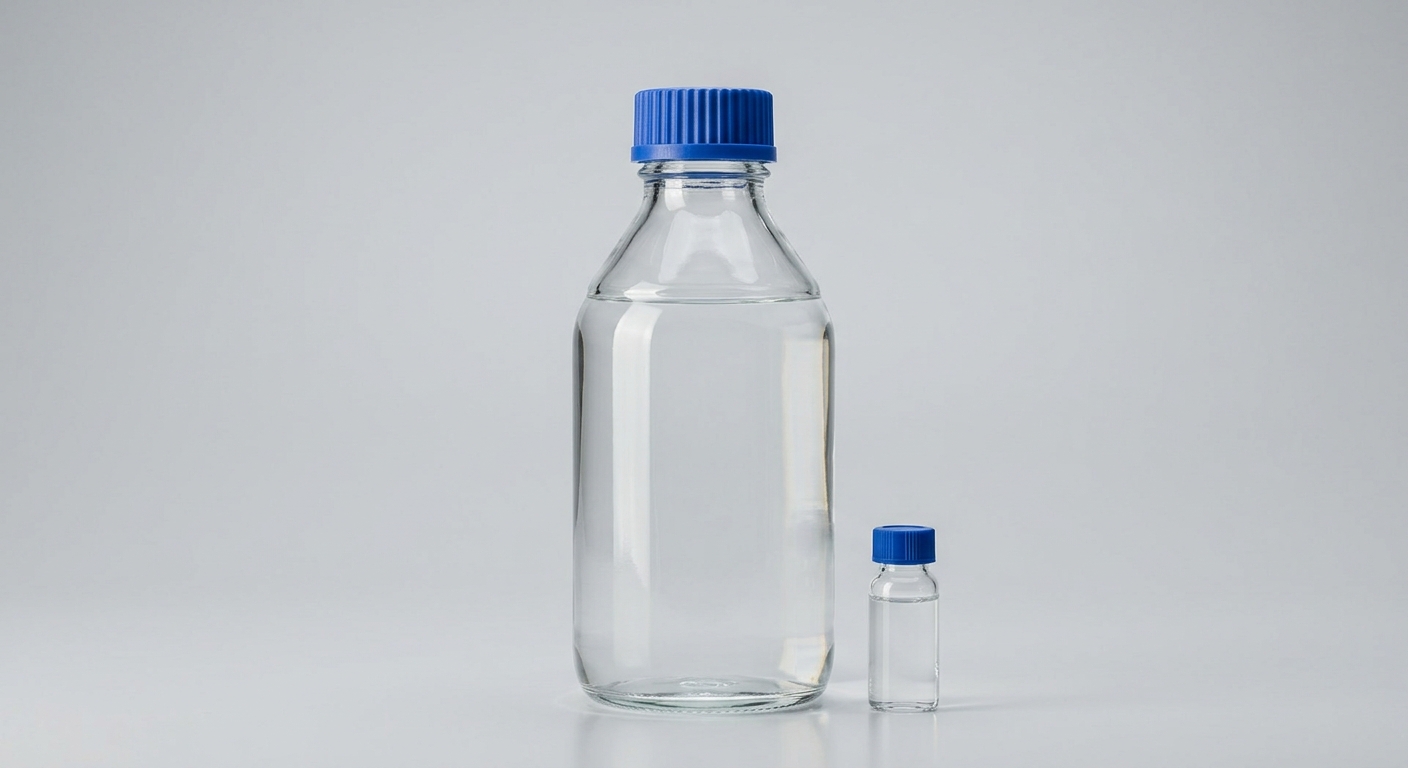
Cyclopentyl methyl ether (CPME, C₆H₁₂O) is a hydrophobic ether solvent used in place of THF, 2-MeTHF, MTBE and 1,4-dioxane. It boils at 106 °C, mixes only slightly with water and is relatively stable under both acidic and basic conditions, so a single solvent can often carry a reaction, the aqueous work-up and solvent recovery.
The grade on this page is ≥99.5% CPME with moisture ≤0.5% and benzene ≤0.02%. For organometallic chemistry the moisture figure is the one to plan around: Grignard and organolithium steps need the solvent dried further before use.
Typical users are pharmaceutical and fine-chemical process teams, plus producers of electronic materials and fragrance ingredients.
Product identification
Product identification
| Product Name | CPME (Cyclopentyl Methyl Ether) |
| Other names | Cyclopentyl methyl ether; methoxycyclopentane |
| CAS Number | 5614-37-9 |
| HS Code | 2909.20 |
| Molecular Formula | C₆H₁₂O |
| Molecular Weight | 100.16 g/mol |
| Purity | ≥99.5% |
| Appearance | Colorless liquid |
Quality specification
Quality specification
Sales specification
| Parameter | Specification | Unit |
|---|---|---|
| CPME content | ≥ 99.5 | % |
| Moisture | ≤ 0.5 | % |
| Benzene | ≤ 0.02 | % |
What the limits mean
What the limits mean
Low water miscibility
CPME separates cleanly from water (about 1.1 g CPME dissolves in 100 g water, and 0.3 g water in 100 g CPME), so extractions and washes need no co-solvent swap and the solvent can be recovered by phase separation and distillation.
Moisture ≤0.5%
Adequate for extraction, crystallization and most reaction work. Water-sensitive steps such as Grignard formation or organolithium chemistry need extra drying, for example over molecular sieves.
Benzene ≤0.02%
Benzene is capped at 200 ppm. This matters for pharmaceutical residual-solvent assessments, where ICH Q3C lists benzene as a Class 1 solvent.
Applications
Applications by industry
1
Pharmaceutical and API synthesis
Reaction and work-up solvent for steps that would otherwise run in THF, 2-MeTHF, MTBE or dioxane.
Grignard and other organometallic reactions
Cross-coupling and amination reactions
Metal-mediated reductions
Lewis-acid and Friedel–Crafts reactions
2
Extraction and crystallization
Hydrophobic process solvent for separating products from aqueous streams.
Liquid–liquid extraction and washes
Crystallization and recrystallization
Solvent recovery by phase separation and distillation
3
Polymers, electronic materials and fragrances
Solvent for polymerization and for the synthesis of specialty intermediates.
Polymerization medium
Electronic-material intermediates
Fragrance ingredient synthesis
Technical Specifications
Physical and chemical properties
| Parameter | Value | Unit |
|---|---|---|
| Density (20 °C) | 0.860 | g/cm³ |
| Boiling point | 106 | °C |
| Melting point | -140 | °C |
| Flash point | -1 | °C |
| Solubility in water (23 °C) | 1.1 | g/100 g |
| Solubility of water in CPME (23 °C) | 0.3 | g/100 g |
| Refractive index (20 °C) | 1.4189 | - |
Packaging & Shipping
Packaging, storage and transport
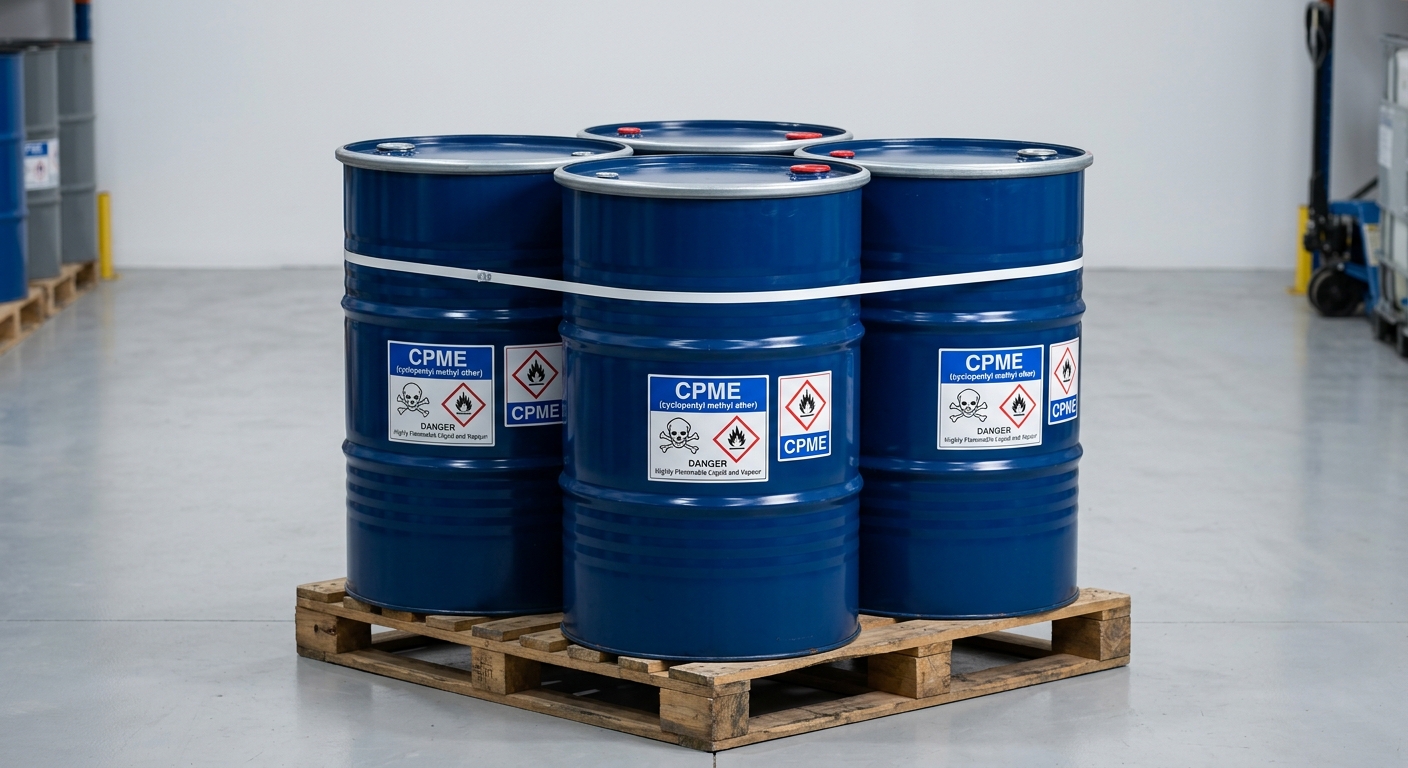
Packaging
Iron drum – 170 kg
ISO tank – Bulk
Shipping & Storage
Storage: Store below 25 °C in closed containers, away from ignition sources and oxidizers. As with other ethers, test for peroxides before distilling or concentrating material that has been stored for a long time.
Hazardous: Yes - DG transport required
Origin: Produced by a large-scale C5 processing partner in Shandong, China. Easier Materials is the export partner.
Commercial terms: MOQ, lead time and delivery terms are quoted per enquiry.
Regulatory and transport data
| Item | Value |
|---|---|
| EC number | 445-090-6 (notified-substance list number) and 611-360-9 (ECHA records) |
| UN number | UN 3271 (ethers, n.o.s.), as listed in supplier safety data sheets |
| Transport class and packing group | Class 3 (flammable liquid), packing group II |
| GHS signal word | Danger |
| GHS hazard statements | H225 (highly flammable liquid and vapor); H302 (harmful if swallowed); H315 (causes skin irritation); H319 (causes serious eye irritation). Some notifications add H312 (harmful in contact with skin) and H412 (harmful to aquatic life with long-lasting effects). |
| HS code | 2909.20 (ethers; cyclanic, cyclenic or cycloterpenic, and their halogenated, sulfonated, nitrated or nitrosated derivatives) |
| ICH Q3C(R9) residual solvent status | Class 2; permitted daily exposure 15.0 mg/day; Option 1 concentration limit 1500 ppm |
| Inventory listings | The substance is listed on the US TSCA inventory and has Japan METI number 3-4548. For EU REACH, registration dossiers for the substance are on the ECHA list; whether they cover a given import route is for the importer to confirm. |
Application chemistry
CPME differs from the ethers it replaces in a few measurable properties. Published values for CPME and the solvents it is compared with:
| Property | CPME | 2-MeTHF | THF | MTBE |
|---|---|---|---|---|
| Boiling point (°C) | 106 | 80.2 | 66 | 55 |
| Solubility in water (g/100 g) | 1.1 (23 °C) | 14 (20 °C) | miscible | 4.2 |
| Water in solvent (g/100 g) | 0.3 | 4 | miscible | - |
| Heat of vaporization (kcal/kg) | 69.2 | 87.1 | 98.1 | 98.6 |
| Water azeotrope, boiling point (°C) | 83 | 71 | 64 | - |
| Water azeotrope, solvent/water (wt%) | 83.7/16.3 | 89.4/10.6 | 94.0/6.0 | - |
| Flash point (°C) | -1 | -11 | -14.5 | -28 |
| Autoignition temperature (°C) | 180 | 270 | 321 | 375 |
| Explosion range (vol%) | 1.1–9.9 | 1.5–8.9 | 2–11.8 | 1.6–15.1 |
| ICH Q3C class | 2 | 3 | 2 | 3 |
Published work documents CPME in Grignard additions, hydride reductions (NaBH₄, LiAlH₄, i-Bu₂AlH), reactions with n-BuLi, Suzuki–Miyaura coupling, Buchwald–Hartwig amination, Lewis-acid and Friedel–Crafts reactions, and in extraction, crystallization and polymerization. Because CPME separates from water, the aqueous work-up can run in the reaction solvent; published process comparisons show the ethyl acetate extraction and solvent-swap steps needed after a THF reaction dropping out.
Residual-solvent limits under ICH Q3C(R9) shape the choice. CPME was added in 2021 as Class 2 at 15.0 mg/day (1500 ppm), compared with 7.2 mg/day (720 ppm) for THF, 6.0 mg/day (600 ppm) for dichloromethane, 3.8 mg/day (380 ppm) for 1,4-dioxane and 2.9 mg/day (290 ppm) for hexane. 2-MeTHF and MTBE are Class 3 (up to 50 mg/day without justification). Benzene is Class 1, to be avoided, with a 2 ppm limit in the drug product.
How this grade compares
Published CPME grades include ≥99.5% content by gas chromatography stabilized with BHT, which is the content limit of the grade on this page (≥99.5%, moisture ≤0.5%, benzene ≤0.02%). A process that needs a limit on peroxides, a specific stabilizer or moisture lower than the ≤0.5% ceiling, for example for organometallic steps, states it in the enquiry.
Storage and shelf life
Autoignition temperature 180 °C, against 321 °C for THF; explosion range 1.1–9.9 vol% in air.
Published CPME grades are stabilized with BHT at about 50 ppm. As with other ethers, stored material is tested for peroxides before it is distilled or concentrated.
Documentation
Documentation
TDS and MSDS available on request
FAQ
Frequently Asked Questions
Related Products
Related Products
Request a Quote — CPME (Cyclopentyl Methyl Ether)
Receive a customized quote within 24 hours. Our technical team is ready to assist with specifications, compatibility, and pricing.